
The first time I ever tried investing was back in 7th grade.
We had just learned about the Great Depression in math and social studies, and our teacher decided to make it real for us. She set up a class stock contest using Yahoo Finance.
Each of us got $10,000 of fake money and two months to see who could make the most.
I had no idea what I was doing. I remember buying McDonald’s and Nomura Holdings because I saw them in a YouTube video about “safe stocks.” It sounded smart at the time.
Netflix, on the other hand, was doing terribly that year, so I avoided it. But one classmate went all in on Netflix, and ended up winning the whole thing. The stock went up like crazy, and suddenly he was the champion.
That was when I first saw how powerful luck and timing could be.
Now, a few years later, I am in my school’s investment club. We use MarketWatch and each start with another $10,000 of virtual money. It is fun, but it also feels a little dangerous in a way.
Since it is not real money, people take wild risks. One of my friends bought a penny stock and doubled his account. Another tried a meme stock that exploded for a week.
Watching that happen was exciting. I will admit it – part of me wanted to try it too. I wanted to see my portfolio shoot up like theirs. It is the same feeling as watching someone win a jackpot. You know it is probably luck, but you still want to experience it yourself.
That temptation to take a big swing is still inside me. Even now, I sometimes think,
“What if I put everything into one stock and it works?
I know that is not real investing, but it is hard to ignore the thought. Maybe that is my biggest weakness as an investor that voice in my head that wants to get rich fast.
I think a lot of people feel it, not just students. The market moves fast, social media shows everyone’s wins, and it feels like you are missing out if you are not making huge profits. But real investing is not about chasing what’s hot.
It is about time, patience, and small, smart steps that build up quietly.
When I look back, I realize that contests and simulators taught me more than just how to buy or sell stocks. They taught me what it feels like to deal with greed, fear, and temptation. And maybe that is the real lesson.
The Portfolio I Forgot About
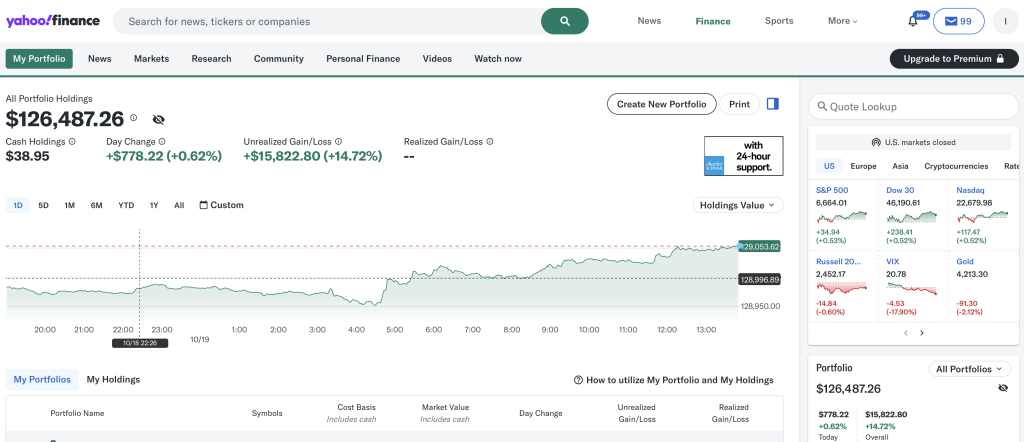
Today I opened my old Yahoo Finance portfolio from my 7th grade stock contest, just out of curiosity. I had started it with $10,000 back then, but later I kept adding more virtual cash to $100,000 and buying random stocks just for fun. It had been sitting there for a few years, untouched.
When the page loaded, I could not believe the number on the screen $126,487.26, up more than 14% overall. I laughed because I had completely forgotten about it. I had not checked or managed it at all. Somehow, doing nothing worked better than trying too hard.
It made me think about what people always say: sometimes the best investor is the one who forgets they even invested. While I was busy learning, studying, and watching my new accounts every day, this old portfolio just grew quietly on its own.
Most of the stocks I picked were from the post-COVID market bubble, when everything was going up no matter what. The ones I didn’t understand well are the same ones that crashed later. Some of them are still deep in the red. The few that survived pulled the average up, but overall, it wasn’t skill. It was luck.
What I learned
- It is easy to get tempted when you see others win big.
- Real investing is not about luck or fast money.
- Contests teach emotions, not just numbers.
- The hardest part of investing is staying patient when others look like they are winning.
- Sometimes doing nothing is the best strategy.
- The market grows slowly, even when you are not watching.
- Forgetting about an investment can sometimes be the healthiest thing you do.
Leave a Reply